This is definitely not a kitchen blog. These are structured notes on flour so that we can separate the wheat from the chaff.
In the mid-2000s, mom took some baking lessons. The result was a flavorful and beautifully decorated bread – often enjoyed with a lard, garlic, and thyme spread. Mom has never been too fond of the kitchen and yet baking seemed a good hobby: affordable, bounded, easy to share, and tasty.
The problem with home baking is all the hocus-pocus. I’ve heard first account that bread is temperamental, is magical, is an art, is something that cannot be explained. Mix it with limited knowledge and improvisation: baking results will swing a lot.
Agreeably, baking works within parameters. The home kitchen has variables it cannot control properly, like temperature and moisture: somebody leaves a window open, the kitchen heats up by cooking, etc. Industrial bakeries instead measure their processes to a T, making sure they can repeat the baking run multiple times with consistent results.
Documentation and repetition are bread’s best ingredients: writing down all the quantities, times, and steps is necessary for replicable results. Moreover, terminology (i.e. calling things as they are) is key. As a home-baker aficionado, I can just wing it with magic; as an academic at heart I will never be satisfied with anything less than a structured experiment.
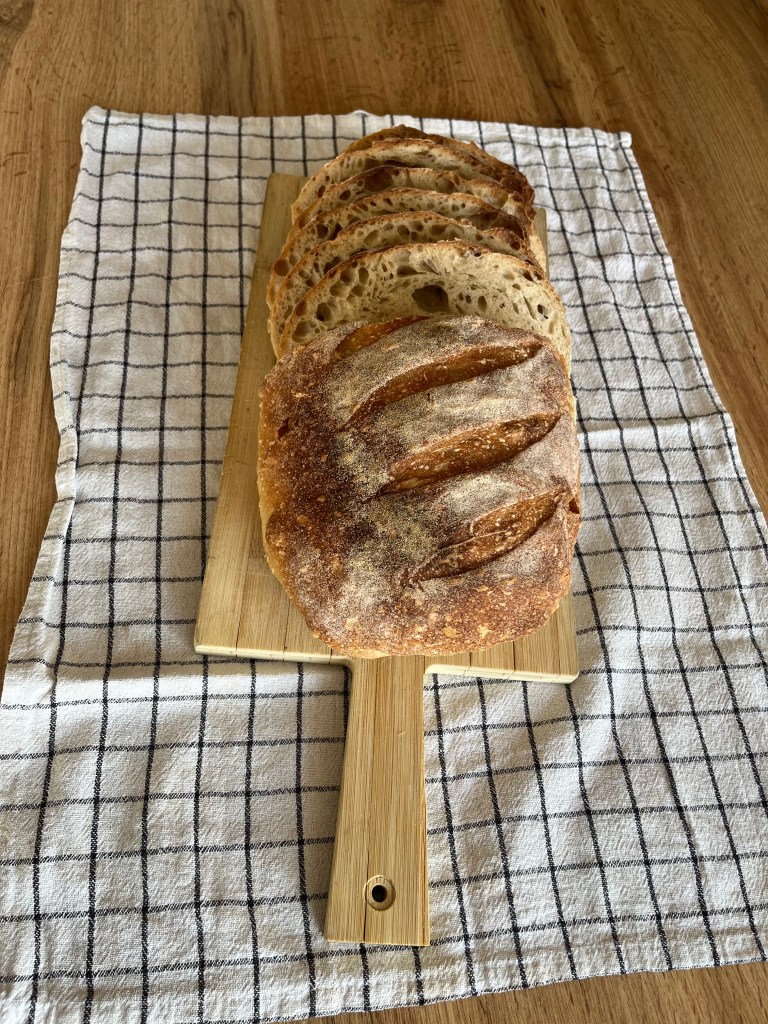
[Picture] My favorite daily bake
- 1Kg white flour (10.5% protein; I got this for 40cents at LIDL)
- 550gr tap water (around 10 degree Celsius)
- 400gr rye sourdough (at 50% rye flour and 50% tap water it’s runny)
- 20gr of table salt
- Mixing, soufflage, reshaping, reshaping again, proofing, and baking totaling around 7 hours.
The many steps:
- Mix flour with water. Once mixed, mix with the sourdough. Once mixed, mix with salt.
- Slap and fold (aka soufflage or the French fold). Shape into a ball, let it rest until doubled.
- Shape it again into a ball. Let it rest 4+ hours at room temperature (±20C).
- Divide into two loaves. Shape them and let them proof.
- Add steam to your hot oven (I use a plant spray for about 15 seconds). Bake mid-oven at 240C for 10 minutes, then turn the temperature down to 200C for 15 minutes, then let the steam out (by slightly opening the oven) and bake 5-10 minutes until the crust is of the desired color.
- Let the bread cool down for 40 minutes on a rack.
And I said this is no kitchen blog. Surprise!
Cereals aren’t real
Of course cereals exist: it’s a collective name for grass whose fruits I can eat. Cereal is a compliment we give to edible grass because of its function. For the purpose of baking, weeds differ by their nutrients: protein, fat, carbs, minerals, and vitamins.
In taxonomy, plants are divided into families, sub-families, tribes, genus. Grass – from pasture grass to actual cereals – is in the Gramineae family. This family gives us almost everything we call a cereal.
Sub-families group similar plants together. The Pooideae (Poa=fodder; oidea=like) is the most important sub-family in human nutrition since it gives us wheat, barley, rye, and oat. One of its tribes (sub-sub-family) is the source of gluten.
- wheat, barley, and rye are from the Triticus tribe and contain gluten.
- Oats contain no gluten (see below). Their Bromus tribe is the ghetto branch of the family: stronger in nutrients, lower in carbs, they have the looks of proper grass and can grow everywhere.
The rest of the Gramineae includes most grass, bamboos, corn, rice, sorghum and millet. Each of them has its own sub-family. None of them contains gluten.
Buckwheat has nothing to do with wheat. It is not even grass and has a different family altogether (Polygonaceae). It’s closer to rhubarb, quinoa, cacti, and spinach. Of course it contains no gluten.
Welcome Triticus, welcome gluten
Gluten is the reason why we use the Triticus tribe (wheat, barley, and rye) in baking.
Gluten is a spongy mass made by two proteins: prolamin (small, water-soluble) and glutenin (big, stretchy). Plants use these storage proteins to protect and feed their seed. However, prolamins can cause an inflammatory response known as celiac disease: wheat’s gliadin, barley’s hordein, and rye’s secalin are problematic, while oat’s avenin seems safe for all.
Mix wheat flour, water, and salt for an elastic fabric where gliadin is loose, while glutenin holds it back. It takes hours before the other proteins in the flour (i.e. enzymes, like protease) break down the gluten fabric: it is the main reason why a day-old dough is both more extensible and less elastic. There will be a space to discuss autolysis too.
Why gluten matters: gluten makes up to 80% of wheat protein. Which is why we want to check the percentage of protein in the flour before baking. By reading the label we know when we are working with a plain flour (9 grams/100 grams), strong (12), or very strong (15) wheat flour. Low-gluten flour is great for a daily bake. High-gluten flour is great for recipes where elasticity is key (e.g. pizza, or sweets) or when the dough needs to rest longer than a day without losing its stretchiness.
Triticus, gluten.. Can we use plain language?
As a tribe, Triticus contains a lot of the base grains we use in baking. The Triticus tribe (Triticeae) has three main genera: wheat (genus: Triticum), barley (Hordeum), and rye (Secale).
| Common name | Scientific name | Its flour works for |
| Common “Bread” Wheat | Triticum Aestivum | Nearly everything. |
| Durum “Pasta” Wheat | Triticum Durum | Pasta, gnocchi, gives bread a more earthy note |
| Khorasan “Kamut®” Wheat | Triticum Turanicum | Nutty and sweet-ish. Yellow shades. |
| Einkorn, monococco, small farro | Triticum Monococcum | Best not in flour form. |
| Emmer, Khapli, medium farro | Triticum Dicoccum | Best not in flour form. |
| Spelt, spelta, big farro | Triticum Spelta | Best not in flour form. |
| Barley | Hordeum vulgare | Best in beer form. |
| Rye | Secale cereale | Dark and sticky, with a sour taste. Lovely. |
| Triticale | Triticosecale | Wheat-rye hybrid. Its story is mad-scientist material. |
What is important to remember is that all these plants have gluten proteins. It doesn’t matter the marketing: locally sourced Einkorn sourdough will always have gluten. It runs in the (botanical) family.
And cereals are carbs, right?
Cereals are different by their nutrients. We live in a wonderful time where most of us have too many calories available and we have a choice on what we eat. We have the same choice in what we bake: some cereals have a larger share of minerals, while others boast of more fibers. What we care about is a mix of grains that works for our baking purposes.
While cereals have ±70% of carbohydrates, we mix that up quite a bit. On the one hand we have fibers (carbs, but very complex hard to get to carbs), on the other hand we have starch (carbs of the quickest option). Fibers are usually good for digestion, and are largely found in the bran of the kernel. They are almost absent in processed flours. On the contrary, starch is the sugary caloric part of flour, and makes the dough rather sticky.
Lower down the nutrition label, proteins tell us how strong the dough will be. They are mostly gluten and enzymes. The higher their percentage the more reactive your dough. Moreover, higher gluten content means that your dough will hydrate, absorbing a large amount of water.
Pick your flour
As a cottage industry, baking works with a lot of useless jargon. For instance Khorasan wheat is branded Kamut® by its company Kamut International; similarly in Italy any strong flour can be marketed as Manitoba, and this farina Americana led to a small revolution in pizza baking thanks to the Marshall plan. Luckily, in baking there are also industrial standards helping with standardization.
There are three main sources of good information: the sample statistical data, the industrial standard of Chopin’s alveograph, and the nutrition label.
- Statistical samples are awesome to compare different types and species. The US department of Agriculture has extensive data on the nutrients of different flours. Similarly, the EU keeps tabs on the amount of minerals per crop, unfortunately visualized in one of the least informative dashboards I’ve seen. It is interesting because we can easily debunk weird claims of a flour being rich in nutrients when it’s actually more of a fad.
- Chopin’s W is a standardized tensile measure of dough. It is literally a measure of pressure and time: it checks how long your flour can hold a bubble before bursting. The W tells us how strong is the flour and runs roughly from 100 (very weak) to 300 (very strong). A W of ±170 works well for most baking runs.
- The nutrition labels lies a little. It tells us of the type of flour (e.g. 00, 405, etc.) and then gives us some information on the content breakdown. The type of flour is not all that interesting to baking since it matters more in terms of taste and grain than the mechanical process around it. The label, however, tells of fibers, starch, and protein. The moment we know the amount of protein per 100 grams we should have enough information on how the flour behaves. Anything around 11 grams per Kilo works fairly well.
00, 405….. Flour types are kinda misleading
The type of flour tells us little and varies by country. In my native Italy we talk about flour 00, 1, and 2, regulated by the Law 4 July 1967, n. 580 (1), Title II, Art. 7. Similarly, the Germans have flour 405, 550, 1050 (until ±1800). The French name their flour like Soviet tanks: T55, T65, T80, etc.
These names refer to a single item: the amount of minerals left over in ashes. Since most minerals are in the shell (bran) of the grain (kernel) the higher the weight of minerals in ashes the more “whole” the flour. The lowest values are in 00, 405, and T40 flour: it is made almost entirely by the starch-rich inner core (endosperm) of the kernel.
Water absorption depends not only on gluten but also on the amount of damaged starch. This is starch that has been physically broken by the milling process: the finer your flour (you can check the PSI or particle size index), the more the damaged starch. It will get the dough sticky, but at the same time it will make more sugar available in the dough – much like the autolysis process -. Finer flour are likely to get brown and crusty since sugar in the dough gives a fine baked taste (known the dorks as the Maillard reaction).
In a kernel
There are ways of investigating baking that cut through all the gobbledygook. These are the ways of scientific agriculture, farming research, biologists and chemists. In this short post I discussed the grains, their plants, and how to pick a flour that can give average results.
Bread baking is not art. It is more of an iterative experiment where repetition and measurement are the core ingredients. Industrial bakeries know their inputs by the second decimal, and use these knowledge to maximize profit. Home-baking does not work with the same logic. One won’t enjoy it by maximizing profit, but taste. By maximizing taste we can have healthy, predictable, and delicious bread right out of our oven.

Leave a comment