Good academic textbooks are rare, and finding one that explains exactly what you need is like hunting for unicorns. Despite the lack of good books, course manuals sell for top prices and are recommended by lead professors. Is there a way out?
Why not books?
Books don’t have their reader in mind. As a business student I wanted a comprehensive and structured repository of knowledge; I often got a shallow and fragmented explanation of a broader topic. After reading a 100-pages strong chapter, we were still asked to look for additional sources – all the while the large share of useful information is included in three slides. The reason lies in the economics of academic publishers: industry consolidation and the commoditization of knowledge.
Industry consolidation is necessary to operate at scale, and make sure that the book is always available to students and its content adherent to academic jargon. There is only a handful of publishers in the market, and their main business is getting the (few) universities around to adopt their handbook – instead of the same book by another publisher. Therefore, the main goal of an academic book is not just to be sold in large quantities: it is to splash the other books out of the water.
The consequence in terms of book content is for publishers to go to market with a new edition – even when it is unclear whether a new edition is really necessary – and remain as generic as possible to have the best market-fit for their products. This brings textbooks to be:
- unnecessarily long;
- incoherent, re-explaining the same technical terms in different chapters;
- shallow, as only the minimum level of knowledge can sell everywhere.
The main point of adopting one textbook – a structured approach to knowledge transfer – is entirely lost.
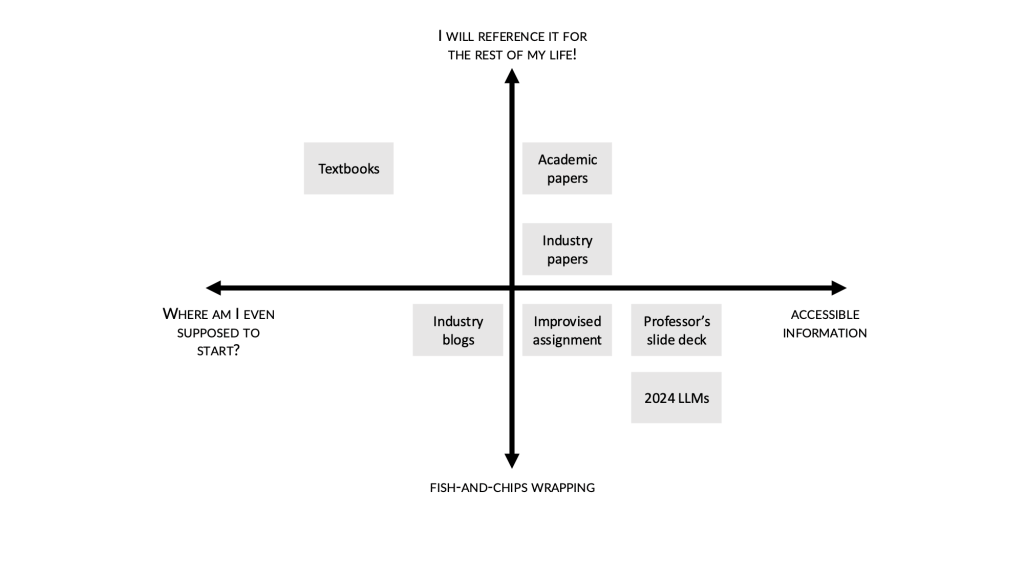
Guidelines for good material
Technical manuals are extremely helpful and good technical manuals should save time instead of taking time: we shall never ask ourselves “were the last 20 pages worth the effort?”. The solution is to realize that this is not the learner’s fault, but rather the content’s.
In the content taxonomy the goals is to aim for the top right corner: accessible content, high production value, and structured explanations.
The more explanatory entries in this blog should follow a few guiding principles:
- keep the reader in mind to make information valuable: it’s the hallmark of good academic papers, written by researchers to researchers to the advancement of academia; and of industry white papers, written to add value to the busy life of professionals – and be entertaining enough to act as marketing stunts;
- structure the knowledge to make sure everybody can access the information needed;
- act timely upon feedback to care about the learning materials.
In other words, it is all open to feedback and if a better explanation is needed..just ask! I am responsible for the stuff I publish.
